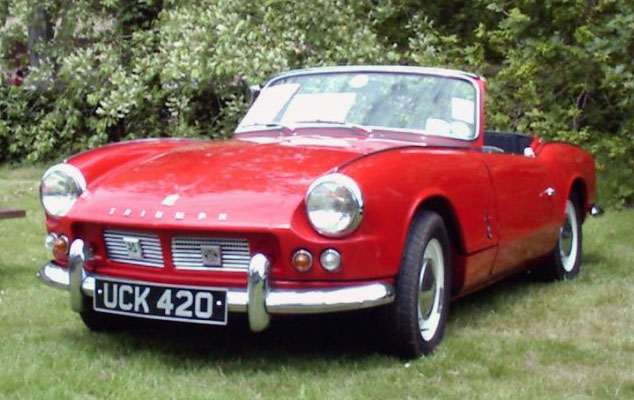


Triumph had not failed to notice the success of the Austin Healey Sprite, and wanted a small sports car of their own to capture a share of this market. The result was the Triumph Spitfire introduced in 1962. It was an eye-catching two-seater sports car based on a modified Triumph Herald chassis with most of its mechanical components also coming from the Herald. The renowned Italian designer Michelotti had been instrumental in styling the Spitfires sleek bodywork.
The first Spitfire to go on sale was powered by the 1147cc Herald engine which had received twin SU carburettors, improved camshaft and had a higher 9:1 compression ratio than that of the Herald saloon. It was badged as the Spitfire 4 with the Spitfire name being taken from the famous WW2 fighter plane, and the ”4” referring to the number of cylinders. This model is now often referred to as the Mk 1. Available options on this (and many of the later models) included an overdrive gearbox, steel hardtop and centre lock wire wheels.
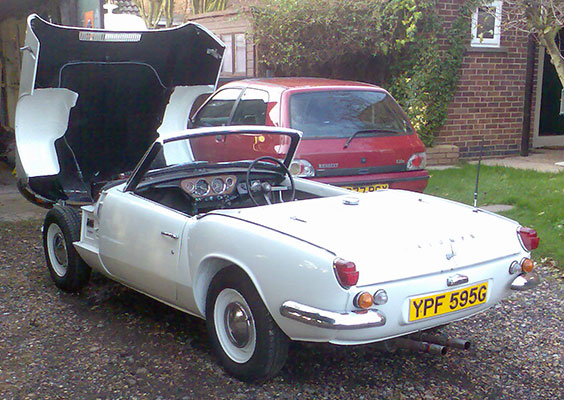
In 1965 the Mark II model was launched, and its engine now produced 67bhp due to a revised camshaft and four branch exhaust manifold. A diaphragm spring clutch was now also fitted. Exterior modifications on the Mk II included a redesigned front grill and emblems on the rear wings, whilst the interior benefited from improved seats, and carpets replaced the earlier models rubber matting. Further improvements were to come with the Mk III which arrived in 1967, the most obvious being styling changes which included a new design of raised front bumper to comply with USA regulations. The engine had been replaced with a 1296cc unit producing 75bhp, and the brakes updated accordingly to cope with the extra performance by enlargement of the front callipers. The interior of the Mk III was complimented by a wood veneer dashboard and better seats. The folding soft-top was also improved and became permanently attached and no longer had to be stored in the boot when not in use.
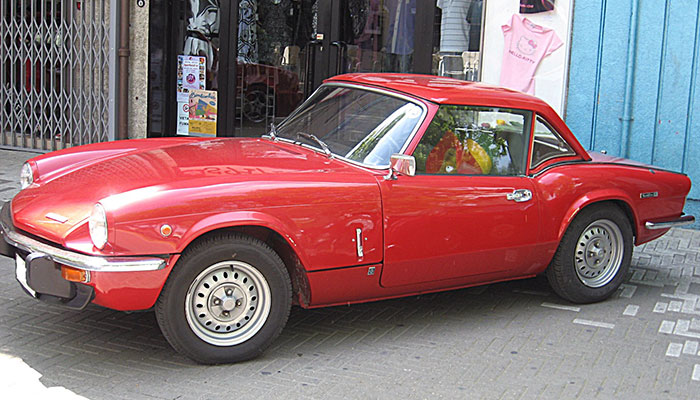
In 1970 Michelotti was brought in to redesign the Spitfire, bringing the looks more in line with other Triumphs in the range which he had recently restyled – or recently designed - such as the Triumph Stag which was launched in June of the same year. New rear light clusters, flared wheelarches and thinner bumpers with plastic underriders were among the styling changes. The whole of the interior was completely restyled and was this restyled car was then launched as the Mk IV.
The Mk IV used the 1296cc engine from the Mk III, although improvements to bearing size and con rods were made. Contrary to popular rumour, the engine was in no way detuned for the Mk IV on its introduction. Yes, the Mk IV was not as fast as the Mk III, but this was due to higher gearing and weight increase more than anything else. Although the Mk IV was quoted as producing only 63 bhp as opposed to 75bhp for the Mk III, it was just that the output was now measured using the German DIN system. However In 1972 the engine was detuned to comply with United States emission regulations. Other mechanical changes to the Mk IV Spitfire were an all synchromesh gearbox and much improved rear suspension. The Mk IV Spitfire was finally replaced with what was to be the last incarnation of the Spitfire - the Spitfire 1500 - in 1974, which continued in production with effectively only minor changes until 1980.
Specifications |
|||||
|---|---|---|---|---|---|
Model |
Spitfire 4 |
Mk II |
Mk III |
Mk IV |
1500 |
Years Produced |
1962-1965 |
1965-1967 |
1967-1970 |
1970-1974 |
1974-1980 |
Body Type |
All Steel, 2 door 2 seater sports bodywork mounted on steel chassis |
||||
Length |
12ft 1in |
12ft 1in |
12ft 3in |
12ft 5in |
12ft 5in |
Width |
4ft 9in |
5ft 1in |
4ft 9in |
4ft 11in |
4ft 11in |
Weight |
1589lb |
N/A |
1736lb |
1717lb |
1890lb |
Engine |
4 cyl 1147cc |
4 cyl 1147cc |
4 cyl 1296cc |
4 cyl 1296cc |
4 cyl 1493cc |
Power (bhp / rpm) |
63 @ 5750 |
67 @ 6000 |
75 @ 6000 |
63 @ 6000 (DIN) |
71 @ 5500 (DIN) |
Torque (lb ft / rpm) |
67 @ 3500 |
67 @ 3750 |
75 @ 4000 |
69 @ 3500 |
82 @ 3000 |
Gearbox |
4 spd manual, synchro on 2nd, 3rd & top (Mk IV & 1500 all synchro) Optional overdrive |
||||
Driven Wheels |
Rear |
Rear |
Rear |
Rear |
Rear |
Brakes |
Disc front, drum rear - dual circuit on 1500 |
||||
Front Suspension |
Independent, coil spring and wishbone |
||||
Rear Suspension |
Independent by transverse leaf spring |
||||
Performance |
|||||
|---|---|---|---|---|---|
Model |
Spitfire 4 |
Mk II |
Mk III |
Mk IV |
1500 |
Top Speed |
92 mph |
95 mph |
100 mph |
90 mph |
101 mph |
0-60 mph |
16.5 seconds |
15.0 seconds |
14.5 seconds |
16.0 seconds |
13.2 seconds |
Fuel Consumption |
32 mpg |
32 mpg |
32 mpg |
33 mpg |
28 mpg |
Useful Links |
|
|---|---|
|
|
To add a link, report an error, or contribute a photograph - click here |
|
Gallery